
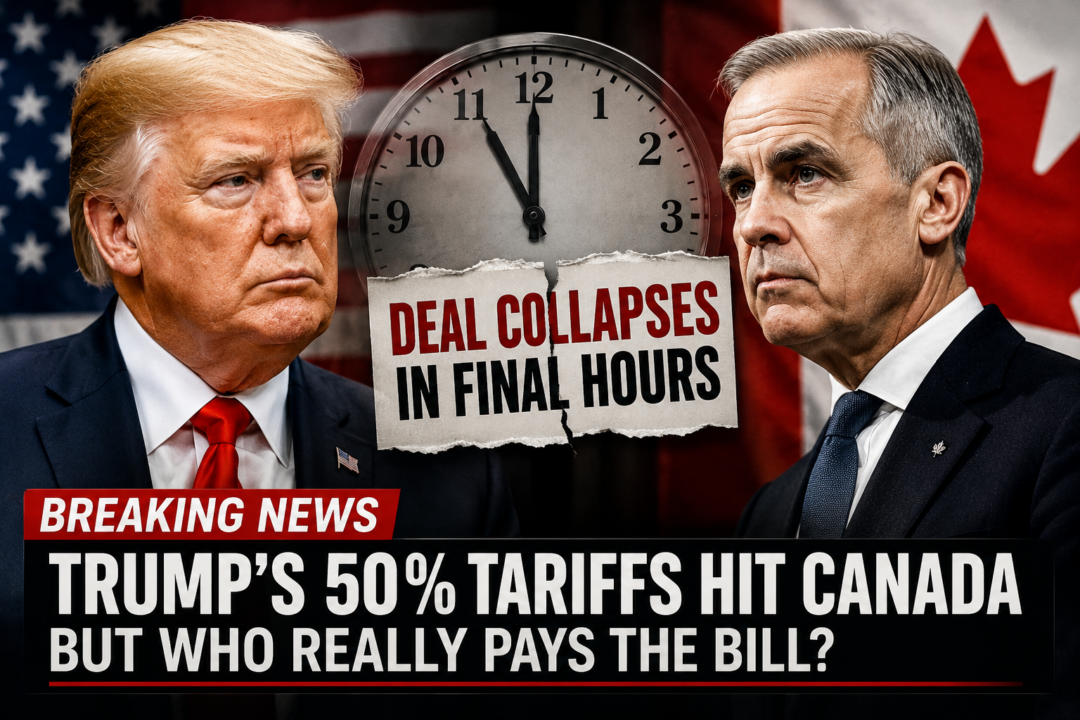

President Donald Trump has a legitimate beef with Canada. Actually, he has several. Canada has spent years enjoying extraordinary access to the American market while maintaining trade policies that Washington says discriminate against American automobiles, dairy products and alcoholic beverages. Trump looked at that arrangement and essentially said enough is enough. Good. Somebody should. But there is a gigantic difference between demanding fair trade and dropping a 50% tariff on imported products as though the only people getting the bill live north of the border. They don’t. American companies pay these tariffs when the products enter the United States, and somewhere along the way Washington needs to remember that those companies employ Americans, manufacture things in America and sell products to American consumers. You can support Trump’s goal while being furious about the weapon he’s using to accomplish it. I am.
Trump Has a Legitimate Case Against Canada
Let’s start with the part Trump gets right because it’s important. According to the Office of the U.S. Trade Representative, the administration imposed these tariffs in response to what it considers discriminatory Canadian policies involving American motor vehicles, alcoholic beverages and dairy products. Canada has restricted access for certain American products while continuing to benefit from enormous access to American consumers. The White House says the new Section 338 tariffs cover nearly $20 billion in Canadian imports, ranging from wine and dairy products to hockey sticks, cement and other goods. Even products that would normally qualify for preferential treatment under the United States-Mexico-Canada Agreement can be hit by these particular tariffs if they’re on the covered lists. Energy, potash, products already covered by Section 232 tariffs and certain other categories are excluded. So Trump’s basic argument isn’t crazy: if Canada wants the advantages of access to America’s enormous marketplace, American producers deserve fair access to Canada’s market too. That’s called reciprocity, and there is nothing radical about demanding it.
But Who Exactly Does Trump Think Pays a Tariff?
Here’s where I start getting aggravated. Politicians love talking about tariffs as though we’re mailing an invoice to Ottawa and Prime Minister Mark Carney grudgingly pulls out Canada’s checkbook. That’s not how this works. A tariff is collected from the American importer when covered merchandise enters the United States. What happens after that depends on the business. Maybe the Canadian supplier lowers its price and absorbs some of the cost. Maybe currency movements soften the blow. Maybe the American importer absorbs part of it and watches its profit margin disappear. Maybe it raises prices. Maybe its customers absorb some of the increase. Maybe everybody gets a piece of the pain. But if you suddenly slap a 50% tariff on an essential Canadian product that an American company has been buying for years, the immediate bill doesn’t magically teleport to Canada. It arrives at an American company’s doorstep. Calling that automatically a “tax on Canada” doesn’t change the mathematics.
Imagine Being a Small American Manufacturer Right Now
Consider a hypothetical American manufacturer that buys a specialized raw material from a Canadian supplier. We’ll say this material represents the majority of what the company sells, the Canadian supplier has been part of its supply chain for years, and there isn’t some magical factory down the street making an equivalent product at the same price and quality. Maybe this American company employs a few dozen people. It pays American salaries, American payroll taxes, American property taxes and American health insurance bills. Its employees buy houses, cars, groceries and Little League uniforms in American towns. Then Washington suddenly tells the company that certain Canadian material it imports could carry an additional 50% tariff. What is the owner supposed to do Monday morning? Raise prices 50%? Customers may leave. Absorb 50%? The company could go broke. Replace the Canadian supplier overnight? With whom? Manufacturing supply chains aren’t Amazon Prime. You don’t click “same-day delivery” on a highly specialized industrial material and have a new qualified supplier sitting on the loading dock by dinner.
This Is Where Broad Tariffs Become Dangerous
That’s my problem with Trump’s love affair with sweeping tariffs. They sound terrific from a podium. “They’ve been ripping us off, so we’re charging them 50%!” Cue the applause. Unfortunately, an economy isn’t a campaign rally. Thousands of American companies operate inside complicated North American supply chains that were built over decades—and in many cases were encouraged by the very trade agreements our government negotiated. A manufacturer might buy Canadian material, process it with American workers in Pennsylvania, Ohio or Texas, and sell the finished American-made product to another U.S. manufacturer. Slap a huge tariff on the Canadian input and congratulations: you’ve just increased the cost of American manufacturing while supposedly protecting American manufacturing. That’s the kind of economic pretzel only Washington could serve with a straight face.
And No, This Doesn’t Mean Canada Gets a Free Pass
Before somebody starts screaming that Jimmy has joined the Canadian parliament, settle down. Canada absolutely should be challenged when it discriminates against American products. If Canadian provinces are keeping American liquor off shelves while Canadian products flow freely into the United States, address it. If Canadian dairy policies unfairly restrict American farmers, negotiate aggressively. If its automobile policies disadvantage American manufacturers, put those policies on the table. Trump is right that the United States has spent far too many years accepting trade arrangements that politicians defended simply because changing them might create a diplomatic headache. America has leverage. We are Canada’s largest customer, and there is nothing wrong with using that leverage. The argument isn’t whether America should fight for fair trade. The argument is whether a 50% tariff across hundreds of product categories is the smartest way to do it.
The Three-Day Pause Showed Trump’s Leverage Was Working
And here’s the frustrating part: Trump’s pressure appeared to be working. The tariffs were originally scheduled to take effect August 19. At practically the eleventh hour, Trump announced a three-day suspension while American and Canadian negotiators worked toward an agreement. Suddenly everybody was talking. Canada was at the table. Reports indicated the discussions could reach beyond these new tariffs and involve steel, aluminum, automobiles, dairy and American alcohol. For a moment, this looked like classic Trump negotiating strategy: put an enormous threat on the table, make the other side believe you’re willing to use it, force negotiations and then make a deal. If that had happened, I’d be standing here applauding. Threatening a tariff can be very different from living with one. A tariff used as leverage that produces a better trade agreement is one thing. A tariff that remains in place for months or years while American companies bleed is something entirely different.
Then the Deal Blew Up
Unfortunately, the deal didn’t happen. Negotiations collapsed Friday after the two sides blamed each other for moving the goalposts. Canada said the United States introduced last-minute demands it considered unfair and economically unacceptable. The Trump administration says Canada was seeking concessions Washington wasn’t prepared to give. And just like that, the three-day honeymoon was over. The 50% tariffs went into effect on roughly $20 billion worth of Canadian products, representing a little more than 5% of Canada’s exports to the United States. Canada responded by suspending trade negotiations and promising dollar-for-dollar retaliation. As of Saturday morning, there are no new negotiations scheduled. So we’ve moved from “Trump threatened a giant tariff and forced Canada to negotiate” to “Trump imposed the giant tariff and now Canada is imposing tariffs on us.” That’s called a trade war, folks, and trade wars have a nasty habit of producing casualties nowhere near the battlefield.
Canada’s Retaliation Makes This Even Dumber for American Businesses
Canada’s promised retaliation is another reason this needs to get resolved quickly. Think about the absurdity. The United States taxes Canadian imports. American companies importing those products face higher costs. Canada retaliates against American exports. American companies selling into Canada face higher costs or reduced demand. Each government then points to the economic damage suffered by the other side as proof that its strategy is working. Meanwhile, the guy running a 40-person factory in Pennsylvania is wondering why he’s apparently been drafted into the Battle of Ottawa without anybody asking him. The American farmer selling into Canada didn’t create Canada’s dairy policy. The American manufacturer importing specialized Canadian material didn’t remove bourbon from a provincial liquor store. Yet these are exactly the people who can end up absorbing the consequences while politicians conduct their international staring contest.
Small Businesses Don’t Have Fortune 500 Escape Hatches
Large corporations have options. They have international purchasing departments, trade lawyers, lobbyists, multiple factories, sophisticated hedging strategies and enough financial muscle to shift sourcing when governments change the rules. Small and midsize American businesses often don’t. A company might have spent 20 years developing a relationship with a Canadian supplier because that supplier makes exactly what it needs. Its customers may have tested and approved that material. Changing suppliers can require months of qualification work. In regulated industries it can take even longer. And even if another source exists somewhere in Europe or Asia, congratulations—we may have just encouraged an American company to stop buying from Canada and start buying from China or some other overseas supplier. Somebody explain how that strengthens North American manufacturing.
A 50% Tariff Can Wipe Out a Company’s Profit Overnight
Here’s another thing Washington seems to forget: most manufacturers don’t have 50% profit margins. Not even close. Imagine a company earning an 8% margin on a product made with Canadian material. Washington imposes a 50% tariff on that input. There isn’t an accounting trick on Earth that makes that disappear. The company either raises its selling price, gets relief from the supplier, finds another source, eats the cost or uses some combination of all four. If competitors source similar products from countries not subject to the same tariff, the American company may not even be able to raise prices without losing customers. That’s how a trade policy designed to “protect American industry” can end up hurting an American manufacturer that was perfectly healthy the day before the tariff arrived. That’s not theoretical economics. That’s basic arithmetic.
Trump Needs a Scalpel, Not a Chainsaw
This is where I part company with Trump’s broader tariff philosophy. I understand why he likes tariffs. They’re immediate. They’re visible. They create leverage. They make foreign governments pay attention in ways another strongly worded letter from the State Department never will. But there is a difference between targeted tariffs aimed directly at a discriminatory industry and broad tariff schedules that catch unrelated American businesses in the blast radius. If Canada is screwing American dairy farmers, target the offending Canadian dairy policies. If Canada discriminates against American automobiles, retaliate against that sector. If provincial governments discriminate against American alcohol, target corresponding Canadian products. But when the tariff net expands far enough to capture industrial materials and products that have little apparent relationship to the original dispute, we’ve gone from precision strike to economic buckshot.
Conservatives Should Be Able to Say This Out Loud
Supporting Trump doesn’t require pretending every Trump policy descended from Mount Sinai on stone tablets. Conservatives spent decades arguing that taxes affect behavior, taxes increase costs and businesses don’t simply pull money out of a magic corporate vault when government raises those costs. We can’t suddenly forget Economics 101 because the tax is called a tariff. A tariff can be a useful strategic tool. It can also be a tax collected from an American importer. Both statements can be true at the same time. Trump can be right about Canada’s unfair trade practices and wrong about how broadly he applies the remedy. If conservative media can’t say that because we’re afraid somebody will call us RINOs, then we’re not analyzing policy anymore. We’re cheering for jerseys.
I Still Think This Gets Resolved
Despite all of this, I don’t believe the United States and Canada are going to remain locked indefinitely in a 50% tariff war over $20 billion worth of products. The two economies are too integrated, the business pressure on both governments will become too intense, and the fact that negotiators already came close enough to justify a three-day pause tells us there is probably a deal somewhere in the middle. Canada depends enormously on access to American consumers. Trump knows that. But Canada also matters enormously to American businesses, farmers, manufacturers and consumers. Carney knows that too. My guess—and let’s be clear, this is a prediction, not a fact—is that both sides eventually return to the table. The real question is how much economic damage they inflict before somebody decides proving who’s tougher isn’t worth the price.
Trump Has the Leverage — Now Make the Deal
Trump’s strongest argument has always been that America finally has a president willing to use the enormous economic leverage that comes with being the world’s most important consumer market. Fine. Use it. Canada should eliminate unfair barriers against American goods. American farmers, automakers and producers deserve reciprocal treatment. But leverage only has value if it produces a better outcome. The goal shouldn’t be collecting tariffs. The goal should be eliminating the unfair practices that made the tariffs necessary. If Trump gets Canada to make meaningful concessions and then removes these tariffs, he can claim a legitimate victory. If this turns into a prolonged trade war where American small businesses get crushed, consumers pay more and Canada retaliates against American exporters while both governments insist they’re winning, then nobody should confuse stubbornness with strategy. President Trump, you’ve made your point. Canada knows you’re willing to pull the trigger. Now get everyone back to the table and make the damn deal.
WE’D LOVE TO HEAR YOUR THOUGHTS! PLEASE COMMENT BELOW.
JIMMY
h/t: Steadfast and Loyal
Leave a Comment