
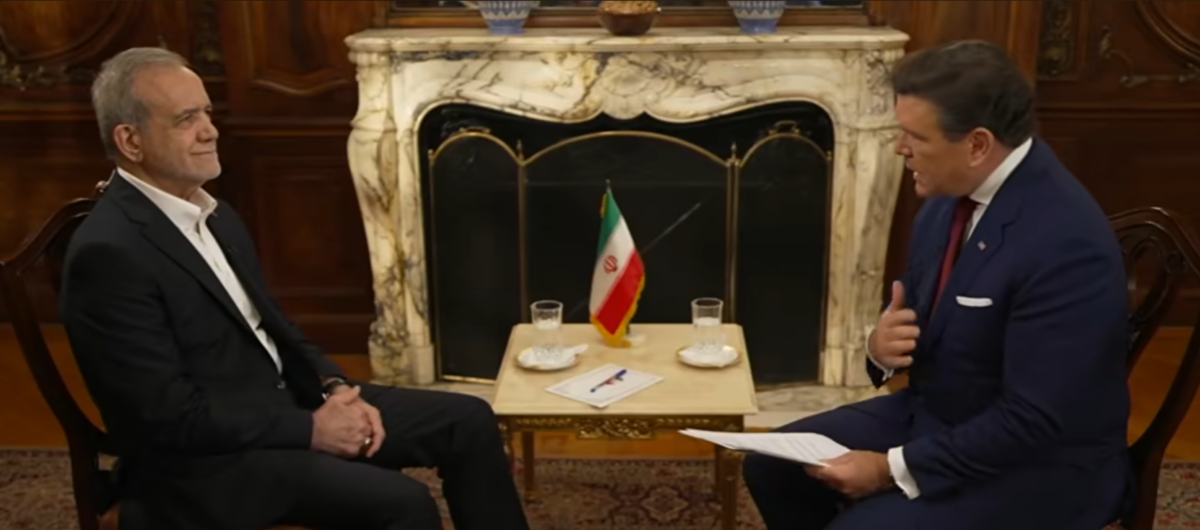

Bret Baier’s interview Thursday with Iranian President Masoud Pezeshkian produced some surprisingly direct answers — and some answers that seemed to go everywhere except where Baier was trying to take them. Pezeshkian plainly denied that Iran wants a nuclear weapon, said Tehran is willing to dilute highly enriched uranium and said Iran would submit its nuclear program to international verification. He also insisted Iran does not want the war to continue and remains willing to negotiate with the United States. Reuters separately reported after the interview that Pezeshkian said it was ultimately up to Washington to decide whether the conflict ends. So on the big-picture question of what Iran says it wants, Pezeshkian was pretty clear: negotiations, sanctions relief, nuclear assurances and an end to the fighting.
Then Bret Started Asking Who Was Responsible
That’s where things got murkier. Baier repeatedly confronted Pezeshkian with examples in which Iranian diplomats allegedly made commitments only for the Revolutionary Guard or other military forces to act differently afterward. After Baier cited attacks on ships following diplomatic agreements, Pezeshkian talked about “lack of coordination” and “misunderstandings.” Baier kept pressing: if Iran’s president signs an agreement, who guarantees the Revolutionary Guard will obey it? Pezeshkian responded by describing communication teams that were supposed to be established under an earlier memorandum of understanding. But the underlying question remained: who actually has the authority to make Iran’s military follow a deal?
“Who Is in Control of Iran?”
Baier eventually asked the question outright. After pointing to multiple instances in which military actions allegedly occurred without Pezeshkian’s knowledge or contrary to previous commitments, Baier asked: “Who is in control of Iran?” It was probably the most important moment of the interview because it gets beyond speeches, diplomacy and promises. Pezeshkian acknowledged that Iran has experienced coordination problems, while elsewhere explaining that his administration implements policy but broader direction comes from the country’s supreme leadership. Iran’s political system is complicated, but Washington’s problem is fairly simple: an agreement only works if the people controlling the missiles, ships and armed forces follow it.
The Same Pattern Appeared on the Toughest Questions
It happened again when Baier asked about the Houthis, protest deaths and allegations involving Chinese satellite intelligence. Pezeshkian denied that the Houthis simply take orders from Tehran, while acknowledging contacts with them. When Baier asked how many Iranians had been killed by Iranian security forces during the January unrest, Pezeshkian challenged outside casualty estimates and defended Iran’s official figures but never supplied a clean number answering that specific question. And when Baier asked about reports that Chinese satellite imagery may have assisted an Iranian strike that killed three American service members, Pezeshkian said he was “specifically unaware” of the reported images. Fox’s own account of the interview confirms that response.
Final Thoughts
Here’s what made this interview worth watching. Pezeshkian did answer questions when Baier asked about Iran’s stated policies. Does Iran want a nuclear bomb? He said no. (Obviously BS..). Will Iran dilute enriched uranium? He said yes (Obviously BS). Will Iran accept verification? He said yes.(Obviously BS) Does Iran want negotiations? Again, yes. But when Baier moved from what Iran says it wants to who ordered what, who is responsible and who can guarantee Iran’s military will obey an agreement, the answers became considerably less precise. That distinction matters. Any future U.S.-Iran agreement will ultimately be judged not by what Pezeshkian says on television, but by whether Iran’s military and political power centers actually carry it out. And after this interview, that may be the biggest unanswered question of all.
WE’D LOVE TO HEAR YOUR THOUGHTS! PLEASE COMMENT BELOW.
JIMMY
Find more articles like this at steadfastandloyal.com.
h/t: Steadfast and Loyal
Leave a Comment