
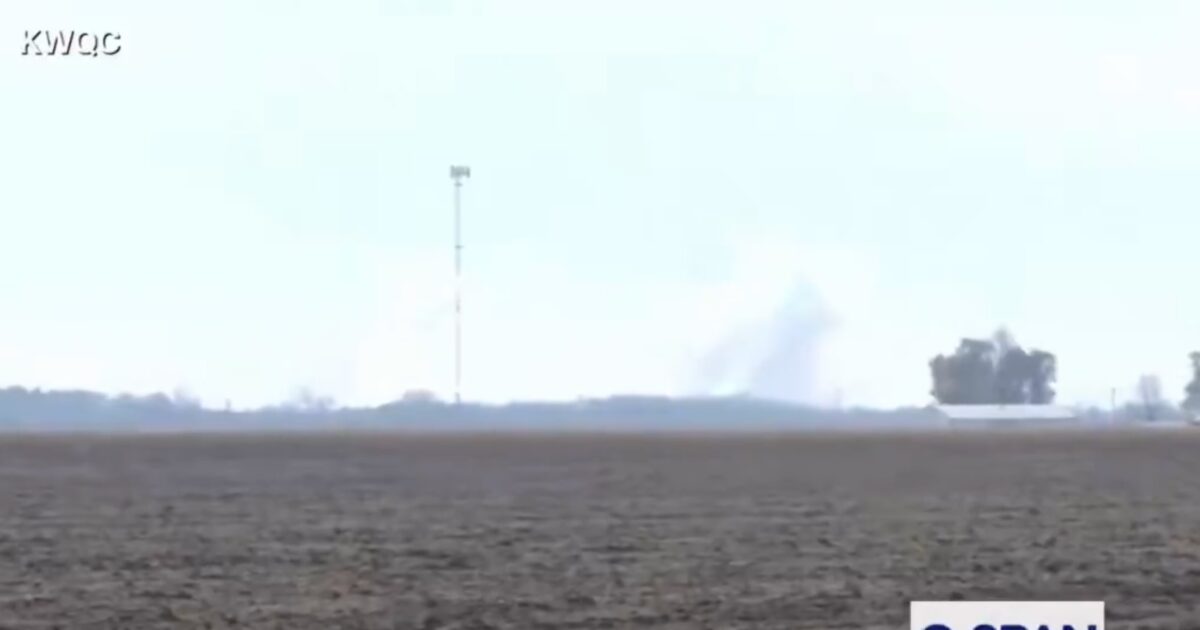

The Iowa lead azide blast has turned a planned U.S. Army disposal operation into a public-safety and political controversy. On Wednesday, the Army detonated nearly five tons, or 68 barrels, of degraded lead azide at the Iowa Army Ammunition Plant in Middletown, Iowa. Yahoo News reported that the blast occurred at 10 a.m. ET. Video showed a plume rising from the explosion, making the scale of the operation impossible to miss. The central issue now is what that plume carried and where it traveled.
The Army did not simply set off the material without precautions. The AP reported that barriers were placed around the blast zone, while ballistic gels were used to absorb lead dust. Those measures suggest the Army recognized the need to control lead dust during the detonation. They also explain why plume tracking matters after the explosion, rather than just during it. Protective steps are worth noting, but they do not by themselves settle the broader questions about exposure or long-term consequences.
WATCH: C-SPAN/KWQC: U.S. Army detonates five tons of bomb chemicals in Iowa.
Iowa lead azide blast sends questions across state lines
The Des Moines Register reported that the Army released hourly maps showing the lead plume’s path. The plume was moving across southeast Iowa and northern Missouri, putting attention on more than the fenced blast zone in Middletown. A map can show direction, but it cannot answer every health question raised by a lead plume. That is why people will focus on the information behind each update, not merely the color or shape of a tracking graphic. Clear explanations matter when people are being asked to judge risk from a distance.
The eventual consequences of the detonation are not established. A Gateway Pundit guest writer argued that the government had refused to answer or consider several questions while Midwestern health might be at risk. That is an allegation and should be treated as such, not as proof that harm occurred. Still, the criticism points to the gap between conducting a technically planned blast and explaining its risks to residents. When the material is toxic and the plume is visible, unanswered questions can quickly fill with fear.
The blast creates a political headache for Trump
The political consequences are already part of the story because the operation could become a public-relations nightmare for the Trump White House. That does not mean the White House caused the detonation or that harm has been established. It means the administration could be associated with the public response, especially if residents believe the warnings are confusing or incomplete. For conservatives who regularly demand competence and accountability from government, this is a simple standard: explain the danger, show the data and answer the hard questions. A massive blast involving toxic material is no place for bureaucratic fog.
Corporate media have compared the explosion to the Chernobyl disaster, while the reporting acknowledges that the comparison may or may not be justified. Deroy Murdock argued, “This fine mess will spread fear and loathing far beyond the lead-azide.” His point was that warnings could push people in Iowa, Missouri, and Illinois to take extreme precautions and disrupt the Thanksgiving and holiday shopping period. Whether that prediction proves fair or exaggerated, dramatic comparisons can overwhelm careful explanations of the actual risk.
Maps, not slogans, will define the next questions
For now, the confirmed facts are limited but serious: the Army detonated the degraded lead azide, a visible plume followed, barriers and ballistic gels were used, and hourly maps are tracking movement across parts of Iowa and Missouri. The unresolved issue is what the operation means for health over time, a question the reporting does not answer. That uncertainty should not be inflated into a disaster claim, but it should not be brushed aside because the blast was planned. Residents deserve precise updates instead of political spin from either side. The quality of the government’s answers will shape whether this becomes a contained disposal story or a lasting trust problem.
C-SPAN/KWQC: US Army detonates 5 tons of bomb chemicals in Iowa pic.twitter.com/S4xYbJFoyv
— Politics & Poll Tracker 📡 (@PollTracker2024) November 25, 2026
WE’D LOVE TO HEAR YOUR THOUGHTS! PLEASE COMMENT BELOW.
Find more articles like this at redrightupdates.com.
Sound off
Join the conversation
Be the first to comment.
Load more comments